What Do UK Degree Classifications Mean? First, 2:1, 2:2 & Marking Criteria
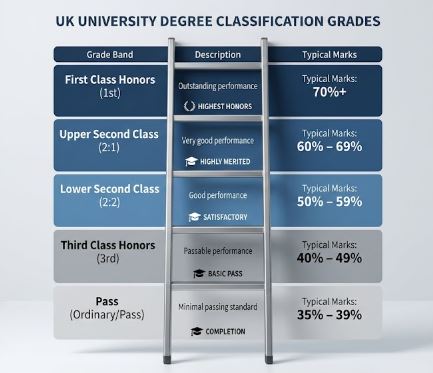
Table of Contents
What Do UK Degree Classifications Mean? (First, 2:1, 2:2 Explained)
Few things cause more quiet anxiety than not really understanding how your work is being judged. You hand in an assignment, get a number back, and have only a vague sense of what it means for your degree. Understanding UK degree classifications removes that fog. Once you know what each band actually requires, you can read your feedback differently and start writing towards the grade you want rather than hoping for it.
This guide explains the UK grading ladder in plain terms, then goes further than most by showing what genuinely separates a 2:2 from a 2:1 and a 2:1 from a First. The percentages are the easy part. The writing behaviours behind them are what really move your grade.
The UK classification system at a glance
UK undergraduate degrees are usually awarded in four classes. A First-class honours (often just “a First”) is the top band. Below it sits the upper second-class, written as 2:1 and spoken as “two-one”. Then comes the lower second-class, the 2:2 or “two-two”, followed by the third-class, or “third”.
The typical percentage boundaries are straightforward: a First is 70% and above, a 2:1 is 60–69%, a 2:2 is 50–59%, and a third is 40–49%. Your final classification is built from your module marks over the relevant years of study, usually with later years weighted more heavily. The exact weighting is set by your university, so check your programme regulations rather than assuming.
It is worth saying early that a 2:1 is the most commonly awarded class and the standard minimum for many graduate schemes and postgraduate courses. It is a strong result, not a consolation prize.
What each grade band actually requires
Percentages tell you where a piece of work landed, but not why. The real story is in the quality of thinking and writing. Here is what markers are typically looking for at each level.
First-class (70% and above)
First-class work does more than answer the question correctly. It argues a clear position, engages critically with evidence, and draws on wide and current reading. The structure feels deliberate, the referencing is accurate, and the writing is polished. Crucially, a First shows independent thought, where you are not just reporting what sources say but evaluating how convincing they are and reaching your own reasoned judgement.
Upper second / 2:1 (60–69%)
A 2:1 is solid, well-organised work that demonstrates good understanding and some critical analysis. The argument is generally clear and supported by relevant sources. What usually holds a 2:1 back from a First is depth: the analysis stays a little safe, the reading could be wider, or the argument does not push beyond the obvious. Closing that gap is often about adding evaluation rather than more content.
Lower second / 2:2 (50–59%)
A 2:2 shows reasonable understanding but tends to be more descriptive than analytical. It often summarises sources accurately without weighing them up, or answers the question on the surface without digging into the “why” and “so what”. Many capable students sit at a 2:2 not because they lack knowledge, but because they are describing when they should be analysing.
How tutors read a marking rubric
Marking is more consistent than it can feel. Most modules use a rubric with criteria such as critical engagement, use of evidence, structure and coherence, and presentation including referencing. When a marker assesses your work, they are matching it against grade descriptors for each criterion, then forming an overall judgement.
This is good news, because it means rubric language is a map. Phrases like “critical engagement with the literature” or “evidence of wider reading” are not vague praise; they are instructions. If your feedback repeatedly mentions one criterion, that is exactly where your marks are leaking. Our guide on UK assignment command words explained helps you decode the instruction verbs in your brief, which is the first step to hitting the rubric.
To make this concrete, imagine a rubric line that says “demonstrates critical evaluation of sources, worth 30% of the mark.” A descriptive answer that lists what three authors say might score poorly on that line even if every fact is correct because it never evaluates. An answer that compares those authors, notes where they disagree, and explains which argument is more convincing scores highly on the same line with broadly the same reading. The content is similar; the marks differ because of how the evidence is used. Reading your rubric this way, criterion by criterion, tells you precisely where to spend your effort while also helping you understand Academic Concerns and Their Impact on Assignments, particularly how critical thinking and effective use of evidence influence academic performance.
If you want help interpreting your own rubric and feedback, our university assignment help service pairs you with subject specialists who can show you, on your own work, where the grade is being lost.
Turning feedback into a higher grade
Feedback is the most undervalued resource you have. Most students read the mark, feel a flash of emotion, and move on. The students who climb a classification do the opposite: they treat feedback as a checklist for the next assignment.
A practical method is to collect comments from several pieces of work and look for patterns. If “too descriptive”, “needs more critical analysis” or “where is your argument?” keeps appearing, the fix is consistent. After each point you make, ask “so what?” and “how do we know?”, then add the evidence and evaluation that answers those questions. This single habit is often what moves a paragraph from 2:2 to 2:1 quality.
Our guide on descriptive vs critical writing shows that shift in action with a before-and-after rewrite, and our breakdown of how to write a first-class university assignment covers the planning and structure habits that support higher marks.
A quick before-and-after example
Imagine a sentence in a marketing assignment: “Social media is widely used by brands to reach customers.” That is descriptive and true, but it earns little. A 2:1 version adds analysis: “Social media lets brands reach customers directly, but its effectiveness depends on platform fit; a campaign that thrives on a visual platform may fail on a text-led one, which suggests channel choice matters more than presence alone.” The second version weighs the idea, draws a conclusion, and signals critical thinking. That is the level shift markers reward.
Why so many students stall at a 2:2
The honest answer is that university rewards a different style of writing than school often did. Many students arrive able to explain and summarise extremely well, which is precisely what a 2:2 looks like. The leap to a 2:1 or First is not about working harder at the same thing; it is about changing what you do, by analysing, evaluating and arguing rather than reporting.
There is no trick or shortcut here, and you should be wary of any service that promises one. Genuine improvement comes from building the underlying skills, which is exactly what ethical academic support should help you do. If you are resitting a module after a disappointing result, our resit assignment help service focuses on understanding what went wrong so the next attempt is stronger.
What about Master’s grades and borderline marks?
Postgraduate study uses a different scale, which surprises many students moving up from a Bachelor’s degree. Taught Master’s degrees are usually classed as Distinction, Merit or Pass rather than First, 2:1 and 2:2. A Distinction is commonly awarded at 70% and above, a Merit at 60–69%, and a Pass at 50–59%, though the exact thresholds and any required average vary by institution and programme. Expectations also rise: at Master’s level, the critical analysis and independent argument that earn a First at undergraduate level are the baseline rather than the ceiling.
Borderline marks deserve a word too. If your average sits just below a boundary, many universities apply borderline or classification rules that can lift you into the higher band, for example where a certain proportion of your credits already sit in that band. These rules are set locally and are not automatic, so the safest approach is never to rely on them. Treat every assignment as if it could be the one that decides your classification, because cumulatively, it is.
A useful mindset is to stop thinking in terms of a single final number and start thinking module by module. Each assignment you lift from a 2:2 to a 2:1 nudges your weighted average upward. Small, consistent gains across a year add up to a different classification far more reliably than hoping for one standout result at the end.
Conclusion
UK degree classifications are not a mystery once you understand them. A First requires critical, well-evidenced, independent thinking; a 2:1 requires solid analysis supported by a clear argument; and a 2:2 often describes where it should evaluate. Knowing this allows you to read your rubric and feedback as practical guidance rather than judgement. If you are unsure how to improve, remember Why Asking for Help Is a Strength, Not a Weakness—seeking advice from lecturers, tutors, or academic support services can help you better understand assessment criteria and improve your future grades.
If you keep landing just below the band you are aiming for, focused support can make the difference. The team at AssignmentFix offers ethical guidance, model answers and detailed feedback through our professional assignment writing service, so you can see exactly what higher-grade work looks like in your subject and build the skills to produce it yourself.
Recent Posts
Ready to Get Your Assignment Sorted?
Don’t let another deadline push you into panic mode. Send us your task, relax for a while, and let our writers prepare work you’ll feel proud submitting.
119,70+
Papers successfully delivered
1300
Verified student clients supported
491
Subject-specialist academic writers
4.7
Average client satisfaction score
Frequently Asked Questions
Have any queries in your mind about our best assignment writing services UK? Browse our FAQs to clear your mind through the most frequently asked questions by students.
A 2:1, or upper second-class honours, is typically awarded for an average of 60–69%. Above it, a First requires 70% or more, while a 2:2 sits at 50–59% and a third at 40–49%. Final classifications are built from weighted module marks set by your university.
Yes. A 2:1 is the most commonly awarded classification in the UK and is the standard minimum requirement for many graduate schemes, professional roles and postgraduate courses. It demonstrates solid understanding and analytical ability, so it is widely respected by employers rather than seen as a fallback result.
First-class work shows critical analysis, wide and current reading, a clear argument and accurate referencing, all in a well-structured piece. It does not just report what sources say; it evaluates how convincing they are and reaches an independent, reasoned judgement that directly answers the question set.
The most common reason is writing that describes rather than analyses. Capable students often summarise sources accurately but stop short of weighing them up or arguing a position. Adding evaluation, asking “so what?” after each point, and answering the question’s deeper “why” usually lifts the grade.
Your classification is built from your module marks across the relevant years, usually with later years weighted more heavily than earlier ones. The exact weighting and any borderline rules are set by your university’s regulations, so always check your programme handbook rather than relying on general percentages alone.