Reflective Writing Explained: How to Use Gibbs’ Reflective Cycle (UK Guide)
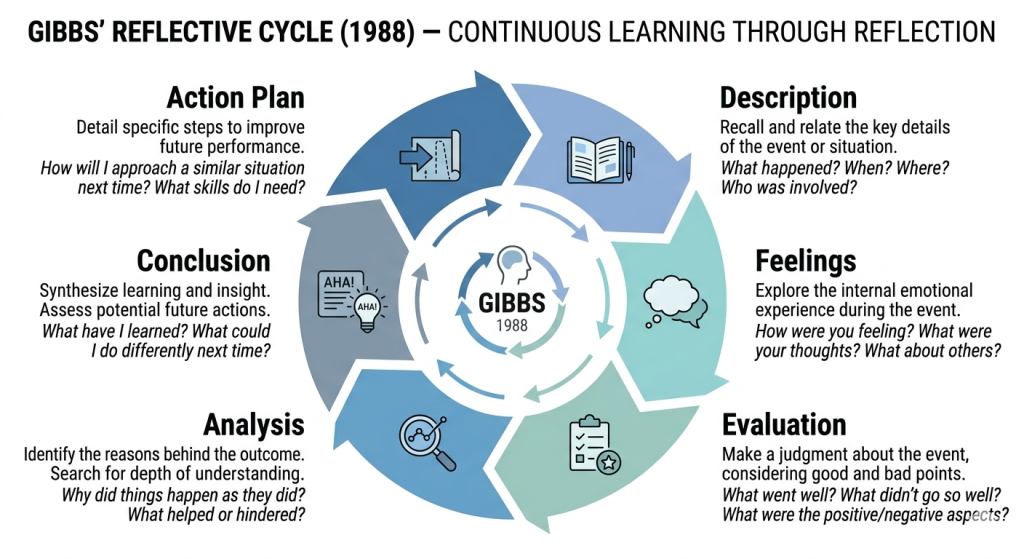
Table of Contents
For many UK students, the first reflective assignment is a genuine shock. You have spent years being told to write objectively, avoid “I”, and stick to the evidence. Then a nursing, teaching or CIPD module asks you to reflect on your own experience in the first person, and the rules seem to flip overnight. Reflective writing is a distinct academic skill, and once you understand its purpose and a reliable structure, it becomes one of the more rewarding things you will write.
This guide explains what reflective writing is, walks through Gibbs’ Reflective Cycle stage by stage, and shows with a worked example how to stay analytical rather than slipping into a diary. By the end, you should be able to approach a reflective task with a clear plan rather than a blank page.
What reflective writing is (and isn’t)
Reflective writing explores an experience to learn from it. Rather than reporting facts about the world, you examine something you did or witnessed, unpack what happened and why, and draw out lessons that will change how you act in future. It is personal, but it is not casual. The goal is structured learning, not storytelling.
This is where many students go wrong. A reflective piece is not a diary entry that simply recounts events, nor is it a confession of feelings for its own sake. Feelings have a place, because they affect decisions, but they are a starting point for analysis, not the destination. The marks come from what you make of the experience: the insight, the connection to theory, and the concrete plan for doing better.
It is also not the place for vague generalities like “I learned a lot and will try harder. Strong reflection is specific. It names what happened, identifies exactly what you would change, and explains why that change is grounded in evidence or professional standards. That specificity is the difference between a pass and a strong mark.
Gibbs’ Reflective Cycle, stage by stage
One of the most widely used frameworks in UK courses is Gibbs’ Reflective Cycle, developed by Graham Gibbs in 1988 to give structure to learning from experience. The University of Edinburgh’s Reflection Toolkit explains the model clearly and is a reliable reference if you want to read more. The cycle has six stages, and its strength is that it carries you from simply describing an event all the way to planning future action.
Description and feelings
The first two stages set the scene. In the description stage, you explain what happened factually and concisely: the situation, who was involved and what you did. Keep this tight, because it is the lowest-scoring part. In the feelings stage, you note what you were thinking and feeling at the time. This matters because emotions shape decisions, and naming them honestly is the foundation for the analysis to come.
Evaluation and analysis
This is where the real marks live. In the evaluation stage, you weigh up what went well and what did not. In the analysis stage, you go deeper and ask why, bringing in theory, research or professional guidance to make sense of the experience. This is the point where reflective writing becomes genuinely academic, because you are connecting personal experience to a wider evidence base rather than just narrating.
Conclusion and action plan
In the conclusion stage, you summarise what you have learned and what you might have done differently. The action plan is the most forward-looking and often the highest-value stage: you set out specific, realistic changes for next time. Vague intentions score poorly here; concrete, evidence-informed actions score well. If you take one thing from Gibbs, make it a strong action plan.
Writing in the first person without rambling
Although reflective assignments are personal in tone, they still need a strong introduction that engages the reader. Learning what is a hook in an essay can help you open your reflective writing with a relevant and engaging first sentence while maintaining an academic style.
A useful discipline is to make sure every personal statement does some work. If you write “I felt anxious”, follow it with why that mattered and what it led to. The structure of a PEEL paragraph can help even here, with your point and feeling, the evidence of what happened, the explanation that links to theory, and the link forward to your action plan. The same critical instinct covered in our guide on descriptive vs critical writing applies: do not just describe the experience, interrogate it.
A worked reflective paragraph
Here is a short, anonymised example using the cycle. “During a placement shift, I was asked to explain a medication change to a patient and realised I did not fully understand the rationale myself (description). I felt exposed and worried about giving incorrect information (feelings). On reflection, I handled it reasonably by saying I would check and return, but I should not have been caught unprepared (evaluation). Linking this to the principle of evidence-based practice, my discomfort came from acting beyond my current knowledge rather than pausing to confirm it (analysis). I have learned that admitting uncertainty is safer than guessing (conclusion). In future, I will review medication rationales at the start of a shift and confirm anything unfamiliar before speaking with a patient (action plan).”
Notice how brief the description is and how much weight sits on analysis and action. That balance is what markers look for.
If a reflective assignment is looming and you would value expert guidance, our CIPD assignment help service supports HR and people-profession students with the reflective tasks built into many CIPD qualifications.
Where reflective writing is used: nursing, CIPD and education
Reflective writing is most common in professions where learning from practice is essential. Nursing and other healthcare courses use it heavily, partly because the Nursing and Midwifery Council expects reflective practice as part of professional development. CIPD qualifications in human resources and learning and development build reflection into many units, and teacher-training courses use it to develop classroom practice.
In each of these fields, reflection is not an academic box-ticking exercise; it mirrors what qualified professionals do throughout their careers. Learning to do it well now is a transferable skill that will follow you into practice. For healthcare students specifically, reflection sits alongside other discipline conventions, which we cover in our guide on how to write a nursing assignment.
How to balance your word count across the cycle
A practical question students always ask is how much to write at each stage. While there is no fixed formula, a useful rough split is to keep description and feelings to around a quarter of your word count combined, devote roughly half to evaluation and analysis, and use the final quarter for the conclusion and action plan. If you’re working within a fixed word limit, such as a university assignment, understanding how to write a 1000 word essay can help you structure your introduction, body paragraphs, and conclusion more effectively while maintaining the right balance across each section. This deliberately starves the part that earns fewest marks and feeds the parts that earn most.
Many students do the opposite by instinct, because describing what happened is the easiest stage to write. If you find your draft is two-thirds description, that is a clear signal to cut. A good editing test is to ask of every sentence in the description: does the reader actually need this to understand my analysis? If not, remove it. The space you free up can go into deeper analysis or a more specific action plan.
Linking reflection to theory and models
What separates strong reflective writing from a personal account is the use of theory. In the analysis stage, naming a relevant model, concept or piece of evidence shows your tutor that you are making sense of the experience through a professional lens rather than relying on instinct alone. For a nursing student, that might mean referencing evidence-based practice or a communication framework; for an HR student, a model of feedback or change.
You do not need to drown the reflection in citations, but one or two well-chosen connections lift the whole piece. The trick is relevance: the theory should genuinely illuminate what happened, not be bolted on to look academic. When the link is real, your reader can see the moment where experience and knowledge meet, and that is exactly what reflective assessment is designed to capture.
Common reflective writing mistakes
A few recurring errors hold reflective writing back. The most common is spending too long on description and too little on analysis and action. Another is keeping the reflection entirely internal, with no link to theory, research or professional standards, which leaves it feeling like a personal anecdote. A third is writing an action plan so vague it could apply to anyone, such as “I will communicate better”, rather than a specific, checkable step.
Avoiding these comes down to balance and specificity. Keep the story short, do the thinking in the middle, and finish with an action plan you could actually be held to.
Conclusion
Reflective writing asks you to learn out loud, turning experience into insight and insight into a plan. Gibbs’ Reflective Cycle gives you a dependable route from describing what happened to deciding what you will do differently, with the analysis in the middle carrying most of the marks. Write personally but purposefully, link your experience to evidence, and finish with a concrete action plan.
If you would like support producing a polished, academically sound reflective piece, the team at Assignment Fix can help through our professional assignment writing service. We provide model reflective work that shows you exactly how to apply the cycle in your own field, so you can build the skill for the long term.
Recent Posts
Ready to Get Your Assignment Sorted?
Don’t let another deadline push you into panic mode. Send us your task, relax for a while, and let our writers prepare work you’ll feel proud submitting.
119,70+
Papers successfully delivered
1300
Verified student clients supported
491
Subject-specialist academic writers
4.7
Average client satisfaction score
Frequently Asked Questions
Have any queries in your mind about our best assignment writing services UK? Browse our FAQs to clear your mind through the most frequently asked questions by students.
Gibbs’ Reflective Cycle is a six-stage model developed by Graham Gibbs in 1988 to structure learning from experience. The stages are description, feelings, evaluation, analysis, conclusion and action plan. It guides you from recounting an event to planning concrete improvements, and is widely used across UK healthcare, education and HR courses.
Yes. Reflective writing explores your own experience, so using “I” is expected rather than discouraged. The key is to keep that personal voice analytical. Every statement about what you felt or did should connect to why it mattered, what you learned, and how you will act differently in future.
A standard essay argues a position using external evidence in an objective voice. Reflective writing examines your own experience to learn from it, using the first person. Both require analysis, but reflection links personal experience to theory and professional standards, ending with a forward-looking action plan rather than a conclusion alone.
The analysis and action plan stages carry the most weight. Analysis is where you connect the experience to theory and evidence, showing genuine academic thinking. The action plan is where you set specific, realistic changes for next time. Vague intentions score poorly, so be concrete and evidence-informed.
Reflective writing is common in nursing and healthcare, teacher training, social work and CIPD human-resources courses, where professional bodies expect evidence of reflective practice. You may also meet it in placement reports and personal-development modules across many subjects, so it is a broadly useful skill to develop early.