Descriptive vs Critical Writing: How to Add Critical Analysis to Your Assignments
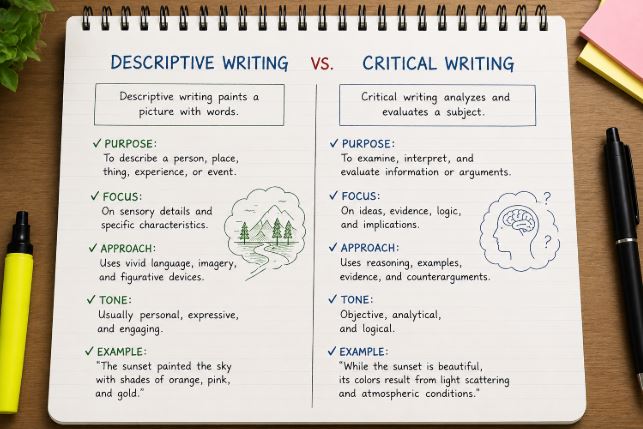
Table of Contents
There is one comment that appears on more UK assignments than almost any other: too descriptive, needs more critical analysis. If you have seen it, you know how frustrating it is. You understood the material, explained it clearly, and still lost marks. The problem is rarely effort or knowledge. It is that university rewards critical writing over description, and the two are genuinely different skills. This guide shows you the difference and, more importantly, how to make the switch.
The good news is that becoming more critical does not mean reading more or writing more. It means doing something different with what you already have. Once you can see the gap between describing and analysing, you can close it deliberately, paragraph by paragraph.
The feedback every student dreads: ‘too descriptive’
Description tells the reader what happened, what a theory says, or what a source claims. It is necessary, but on its own it is low-value at degree level. Critical writing goes further: it asks why something matters, how convincing the evidence is, and what follows from it. Markers reward that second move because it shows you are thinking, not just reporting.
Most students are excellent describers by the time they reach university, because school and college often reward accurate recall. The leap to critical analysis is not about abandoning description; you still need it to set up your points. The difference is the ratio. A descriptive answer is mostly what. A critical answer uses a little what and far more so what and how do we know.
This is also why working harder at the same approach rarely helps. Adding more description to a descriptive essay just makes it longer, not better. The fix is qualitative, and that is encouraging, because it means a relatively small change in how you write can lift your grade significantly.
Description vs analysis vs evaluation
It helps to separate three levels, because critical writing usually blends the last two on top of the first.
Description states the facts: The 2008 financial crisis led to widespread bank failures. Analysis breaks that down and explains relationships: Bank failures spread because institutions were highly interconnected, so one collapse undermined confidence in others. Evaluation makes a judgement about significance or quality: This suggests that interconnection, more than any single bank’s behaviour, was the critical vulnerability, which is why later reforms focused on systemic risk.
Notice that the facts barely change across the three. What changes is the work you do with them. Strong assignments move fluidly between these levels, anchoring each point in evidence and then interrogating it. If your writing tends to stop at the first level, that is your single biggest opportunity for improvement.
A side-by-side paragraph rewrite
Abstract advice only goes so far, so here is the shift in action. Imagine a paragraph in an education assignment.
Descriptive version: Formative assessment is assessment used during learning to give feedback. Many teachers use it. Black and Wiliam wrote about it. It is different from summative assessment, which happens at the end.
That is accurate and entirely descriptive. Now the critical version: Formative assessment is valued because it feeds back into learning while there is still time to act, unlike summative assessment, which arrives too late to change the outcome. Yet its impact depends heavily on what teachers do with the information; feedback that is not acted on adds little. This suggests the real variable is not whether assessment is formative in name, but whether it changes subsequent teaching, which complicates simple claims that formative assessment improves results.
The second paragraph uses the same sources and facts but weighs them, draws a conclusion and even raises a complication. That is critical writing, and it is the level markers are asking for when they write too descriptive.
If you would find it useful to see critical writing modelled in your own discipline, our professional assignment writing service produces subject-specific model answers you can study to see exactly how the analysis is built.
Question prompts that force critical thinking
The fastest way to become more critical is to interrogate your own sentences. After each point you make, pause and ask a short set of questions:
- So what? Why does this point matter to my argument?
- How do we know? What evidence supports this, and how strong is it?
- According to whom? Whose claim is this, and do others disagree?
- What follows? What does this imply or lead to?
- What are the limits? Where might this not hold true?
You do not need to answer all five every time. Even applying one or two converts a flat statement into an analytical one. With practice, these questions become automatic, and your writing shifts from reporting to reasoning without you having to force it. Understanding the instruction words in your brief helps too, which is why our guide on UK assignment command words explained is a useful companion to this one.
Using sources to build an argument, not pad it
A subtle cause of descriptive writing is treating sources as things to report rather than tools to think with. If each paragraph simply says Author A found X, Author B found Y, you are summarising, not analysing. The critical move is to put sources into conversation: where do they agree, where do they clash, and what does that tension tell us?
For example, instead of Smith argues markets self-correct, and Jones argues they need regulation, you might write Smith’s confidence in self-correction sits awkwardly against Jones’s evidence of repeated market failures, suggesting that self-correction may work in stable conditions but break down precisely when it is most needed. Same sources, but now they are building an argument.
This skill underpins higher grades, which is why it connects so directly to the UK degree classifications markers use. It is also the engine of a strong PEEL paragraph, where the explain step is where your critical analysis lives.
Why critical writing feels hard at first
If critical writing feels uncomfortable, that is normal and even a good sign. Description feels safe because it is hard to be wrong when you are simply reporting facts. Analysis and evaluation require you to commit to a position, and committing feels risky. Many students hold back not because they cannot think critically, but because they are nervous about asserting a judgement in case the marker disagrees.
Here is the reassurance: markers are not looking for the right opinion. They are looking for a position that is reasoned and supported by evidence. You can argue that a theory is flawed or that a study is convincing, as long as you show your working. A well-argued conclusion the marker personally disagrees with will still score well, whereas a safe, fence-sitting summary will not. Permission to take a defensible position is often the unlock that turns a capable describer into a confident critical writer.
It also helps to remember that critical does not mean negative. Evaluating fairly means acknowledging strengths as well as weaknesses. A balanced critical paragraph might concede that a model is useful in certain conditions before explaining where it breaks down. That even-handedness is itself a marker of sophisticated thinking.
How this looks across different subjects
Critical analysis takes slightly different forms depending on your discipline, which is worth bearing in mind. In the sciences and social sciences, it often means evaluating methodology, sample sizes and the strength of evidence behind a claim. In business and management, it means weighing the practical limits of a model against real-world conditions. In the humanities, it means interrogating interpretations, assumptions and competing readings of a text or event.
Despite these differences, the underlying move is identical everywhere: do not just report, interrogate. Whatever your subject, the prompt questions in the previous section will guide you to the kind of critical engagement your markers expect, because they all push you from what towards so what.
A practical routine for your next assignment
To make this stick, try a simple editing pass. Once you have a draft, go through it highlighting every sentence that only describes. For each highlighted sentence, ask one of the prompt questions above and add a sentence of analysis or evaluation. You will often find your paragraphs roughly double in analytical content without becoming much longer, because you are replacing filler with reasoning.
If you are juggling several deadlines and want targeted help raising the analytical quality of a specific piece, our university assignment help service can review your draft and show you, line by line, where description could become analysis.
Conclusion
The difference between descriptive and critical writing is the difference between telling the reader what you know and showing the reader how you think. You do not need more facts; you need to do more with the facts you have, by asking why they matter, how strong the evidence is, and what follows. Apply the prompt questions, put your sources into conversation, and run an analytical editing pass before you submit.
If you want to see exactly what strong critical writing looks like in your subject, the team at AssignmentFix can help. Our model assignments and detailed feedback are designed to build your own analytical skills, so the next time you get feedback, it says something far better than too descriptive.
Recent Posts
Ready to Get Your Assignment Sorted?
Don’t let another deadline push you into panic mode. Send us your task, relax for a while, and let our writers prepare work you’ll feel proud submitting.
119,70+
Papers successfully delivered
1300
Verified student clients supported
491
Subject-specialist academic writers
4.7
Average client satisfaction score
Frequently Asked Questions
Have any queries in your mind about our best assignment writing services UK? Browse our FAQs to clear your mind through the most frequently asked questions by students.
Critical writing weighs evidence, compares different viewpoints and reaches a reasoned judgement, rather than simply reporting what sources say. It blends description with analysis and evaluation, asking why a point matters and how convincing the evidence is. At university, this is the style that earns higher marks.
After each point, ask so what?, how do we know? and according to whom?, then add a sentence that answers one of them with evidence or evaluation. Putting sources into conversation, showing where they agree or clash, also turns flat summary into genuine critical analysis.
Descriptive writing explains what happened or what a theory states without weighing it up. Markers reward analysis of why it matters and evaluation of how convincing it is. If most of your sentences answer what rather than so what, your work will read as descriptive and lose marks.
Analysis breaks something down and explains relationships, such as why an event happened. Evaluation goes a step further and makes a judgement about significance or quality, such as which factor mattered most. Strong critical writing usually layers evaluation on top of analysis, both anchored in evidence.
You can be critical without evidence, which becomes mere opinion, and that is a risk. Genuine critical writing is always grounded in sources and reasoning. Being critical does not mean being negative; it means evaluating fairly, acknowledging strengths and limitations, and reaching a judgement the evidence can support.